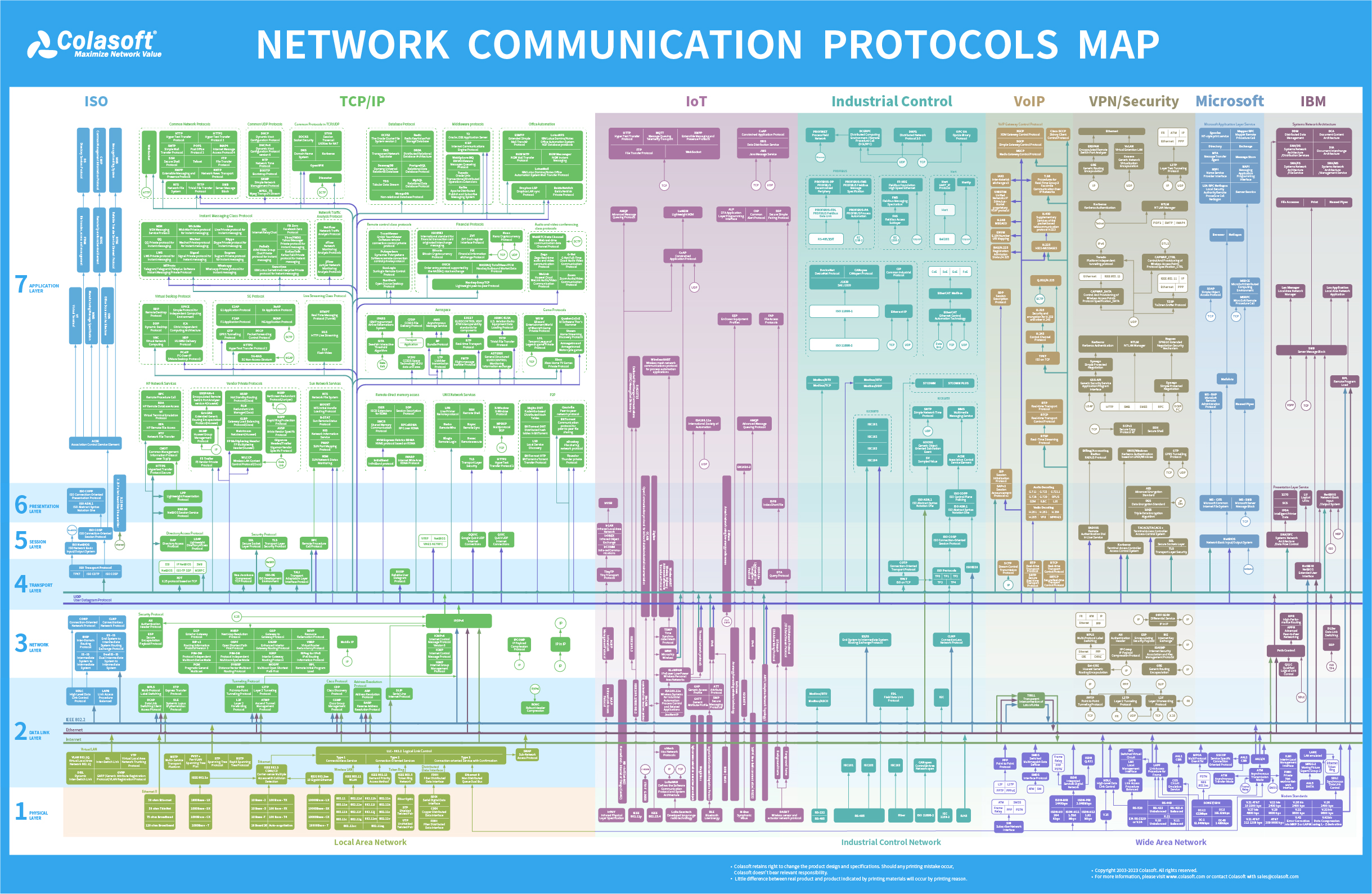
The Colasoft Network Communication Protocols Map provides a comprehensive visual reference for understanding the complex landscape of network protocols. This professionally designed map organizes hundreds of protocols into a clear, hierarchical structure based on the OSI model and protocol categories.
Designed for network engineers, IT professionals, security analysts, and students, this map serves as an essential tool for understanding protocol relationships, troubleshooting network issues, and mastering network architecture. It covers the complete spectrum from physical layer protocols to application layer protocols across different network environments.
Whether you're analyzing network traffic with Colasoft Capsa, conducting forensic analysis with nChronos, or simply learning about network protocols, this map provides the visual reference you need to navigate the complex world of network communications.
| File Size | High-resolution image |
| Language | English |
| File Format | |
| Coverage | 8 Protocol Families, OSI 7-Layer Model |
| Type | Digital Edition |
| License | Free for personal and educational use |
For high-resolution printed versions or custom protocol maps, please Contact Us
Key Features of the Protocol Map
OSI 7-Layer Model Framework
Organized according to the OSI (Open Systems Interconnection) model, with each layer clearly labeled on the left side—from Physical Layer to Application Layer—helping you understand where each protocol operates in the network stack.
8 Major Protocol Families
Comprehensively covers eight protocol families: ISO, TCP/IP, IoT, Industrial Control, VoIP, VPN/Security, Microsoft, and IBM. Each family is color-coded for easy identification and navigation.
3 Network Classifications
Protocols are organized across three network environments: Local Area Network (LAN), Industrial Control Network, and Wide Area Network (WAN), reflecting real-world deployment scenarios.
Visual Protocol Relationships
Connection lines clearly show the relationships between protocols, enabling you to trace protocol dependencies and understand how protocols interact across different layers and families.